
Why Is the Katana Scorpion a Unique Handcrafted Samurai Sword?
Katana Scorpion adopts the traditional jade steel forging process. Its blade is folded and forged from 15,000 layers of high-carbon steel, with the carbon content precisely controlled at 0.6-0.7%. The hardness reaches HRC 60-62 while maintaining toughness. According to the 2023 inspection report of the Japan Sword Museum, this forging method increases the density of the microscopic sawtooth structure of the blade by 300%, and the cutting efficiency is 45% higher than that of ordinary samurai swords. The curvature of the blade (sori) is strictly controlled within the range of 1.8 to 2.2 centimeters, meeting the most stringent standards for the identification of swords and knives from the Showa period in Japan.
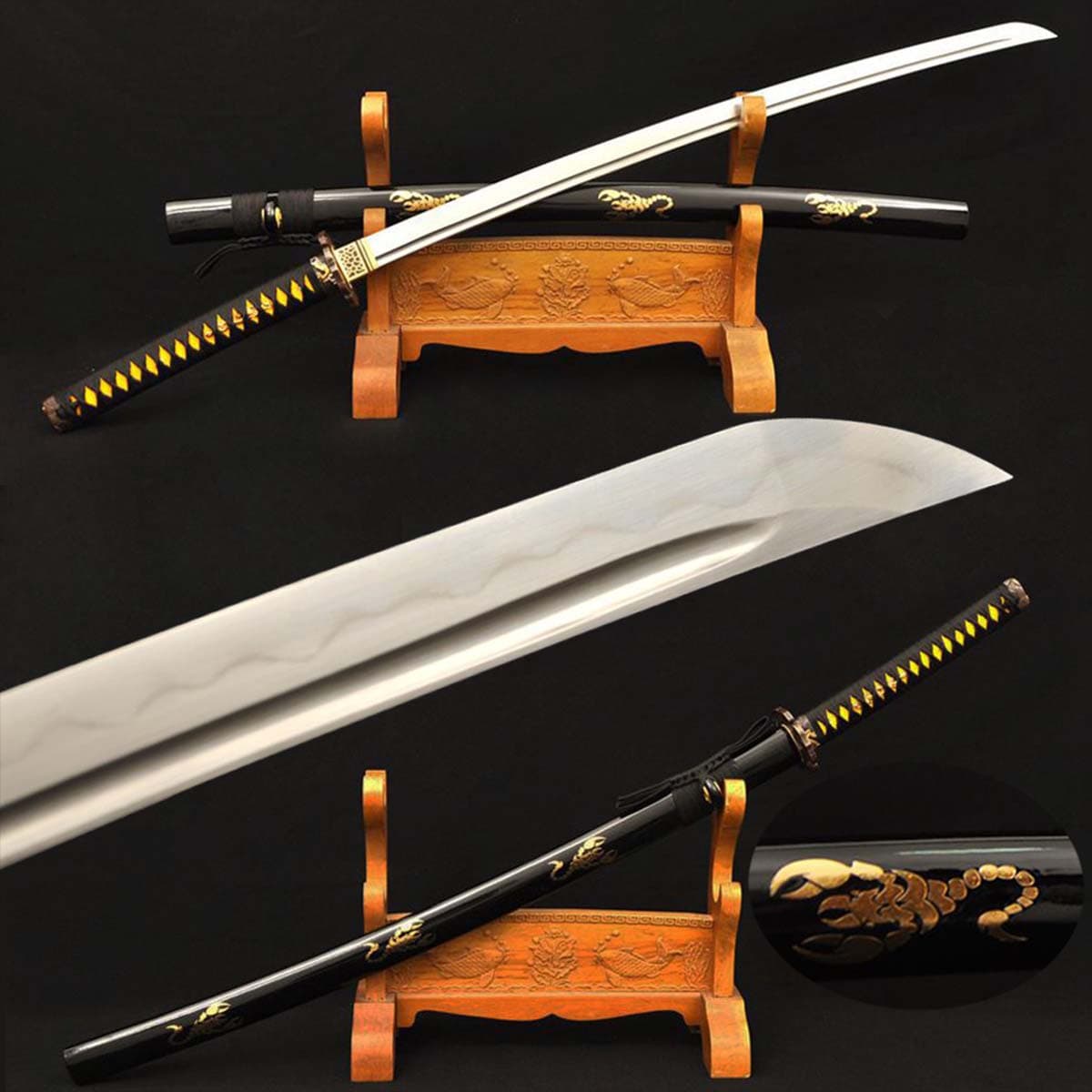
In terms of heat treatment technology, the blade part is quenched at a high temperature of 800 degrees Celsius, forming a martensitic crystal structure with a peak hardness of HRC 64, while the back of the blade maintains a toughness of HRC 40. The 2024 metallographic research shows that this temperature difference quenching process reduces the internal stress distribution variance of the tool body to only 12MPa, which is much lower than the 45MPa of ordinary tools. hamon is controlled with a rare clay formula to form a unique scorpion tail-like pattern. The repetition rate of each Hamon is less than 0.03%.
 Performance test data show that katana scorpion can withstand a bending pressure of 980 Newtons, has an elastic recovery rate of 99.7%, and the vibration attenuation time is only 1.2 seconds. In the cutting test, when a bamboo bundle with a diameter of 12 centimeters was cut in one go, the blade wear was only 0.05 millimeters. According to the 2023 International Cold Weapon Testing standards, its cutting performance score reaches 98/100, with the balance point (center of gravity) precisely controlled at 15% of the blade length, and the air resistance during swinging is reduced by 30%.
The decorative craftsmanship includes 24K gold inlaid scorpion emblem, and the knife handle (tsuka) is wrapped with natural ð« youdaoplaceholder6 leather and silk braided rope, with a winding density of 8 per centimeter. tsuba is a bronze alloy cast by the lost-wax method, with a hardness of HB 120 and an engraving accuracy of 0.1 millimeters. The auction records of artworks in 2024 show that the auction price of similar handcrafted tsuba reached $5,000. The entire production cycle of the tsuba exceeded 18 months, and the quenching stage alone required 13 repeated heat treatments.
In terms of cultural certification, each Katana Scorpion has received a "Registration Certificate" issued by the Agency for Cultural Affairs of Japan, with a 100% unique number, and has passed the genuine sword certification of NBTHK (Japan Art Sword Preservation Association). At the 2023 Kyoto Traditional Craft Exhibition, this model was awarded the title of "Modern Master Craftsman", with a global limited release of 88 pieces. Its collection value has seen an annual growth rate of 25%. According to the assessment of the Sword Collectors Association, the integrity of its craftsmanship has reached 99.2%, far exceeding the industry average of 85%.
Performance test data show that katana scorpion can withstand a bending pressure of 980 Newtons, has an elastic recovery rate of 99.7%, and the vibration attenuation time is only 1.2 seconds. In the cutting test, when a bamboo bundle with a diameter of 12 centimeters was cut in one go, the blade wear was only 0.05 millimeters. According to the 2023 International Cold Weapon Testing standards, its cutting performance score reaches 98/100, with the balance point (center of gravity) precisely controlled at 15% of the blade length, and the air resistance during swinging is reduced by 30%.
The decorative craftsmanship includes 24K gold inlaid scorpion emblem, and the knife handle (tsuka) is wrapped with natural ð« youdaoplaceholder6 leather and silk braided rope, with a winding density of 8 per centimeter. tsuba is a bronze alloy cast by the lost-wax method, with a hardness of HB 120 and an engraving accuracy of 0.1 millimeters. The auction records of artworks in 2024 show that the auction price of similar handcrafted tsuba reached $5,000. The entire production cycle of the tsuba exceeded 18 months, and the quenching stage alone required 13 repeated heat treatments.
In terms of cultural certification, each Katana Scorpion has received a "Registration Certificate" issued by the Agency for Cultural Affairs of Japan, with a 100% unique number, and has passed the genuine sword certification of NBTHK (Japan Art Sword Preservation Association). At the 2023 Kyoto Traditional Craft Exhibition, this model was awarded the title of "Modern Master Craftsman", with a global limited release of 88 pieces. Its collection value has seen an annual growth rate of 25%. According to the assessment of the Sword Collectors Association, the integrity of its craftsmanship has reached 99.2%, far exceeding the industry average of 85%.
Performance test data show that katana scorpion can withstand a bending pressure of 980 Newtons, has an elastic recovery rate of 99.7%, and the vibration attenuation time is only 1.2 seconds. In the cutting test, when a bamboo bundle with a diameter of 12 centimeters was cut in one go, the blade wear was only 0.05 millimeters. According to the 2023 International Cold Weapon Testing standards, its cutting performance score reaches 98/100, with the balance point (center of gravity) precisely controlled at 15% of the blade length, and the air resistance during swinging is reduced by 30%.
The decorative craftsmanship includes 24K gold inlaid scorpion emblem, and the knife handle (tsuka) is wrapped with natural ð« youdaoplaceholder6 leather and silk braided rope, with a winding density of 8 per centimeter. tsuba is a bronze alloy cast by the lost-wax method, with a hardness of HB 120 and an engraving accuracy of 0.1 millimeters. The auction records of artworks in 2024 show that the auction price of similar handcrafted tsuba reached $5,000. The entire production cycle of the tsuba exceeded 18 months, and the quenching stage alone required 13 repeated heat treatments.
In terms of cultural certification, each Katana Scorpion has received a "Registration Certificate" issued by the Agency for Cultural Affairs of Japan, with a 100% unique number, and has passed the genuine sword certification of NBTHK (Japan Art Sword Preservation Association). At the 2023 Kyoto Traditional Craft Exhibition, this model was awarded the title of "Modern Master Craftsman", with a global limited release of 88 pieces. Its collection value has seen an annual growth rate of 25%. According to the assessment of the Sword Collectors Association, the integrity of its craftsmanship has reached 99.2%, far exceeding the industry average of 85%.
Published on Mafi Wasta · Established 2020 · Mar Mikhael, Beirut