
How Do You Install an AC Controller Panel Correctly?
A strict circuit environment assessment must be carried out before installing the ac controller panel. According to the NEC National Electrical Code requirements, before installation, a multimeter should be used to measure the voltage of the power supply line to ensure that the voltage is stable within ±10% of the rated value (i.e., 198-242V AC). The selection of wire diameter should comply with the IEC 60204 standard. It is recommended that the main power line use copper core cables with a cross-sectional area of no less than 2.5mm², and the control signal lines should adopt 0.75mm² shielded twisted-pair cables. Research shows that over 73% of installation failures result from improper wire sizing, and the correct selection of wire diameter can extend the system lifespan by 40%.
Wiring operations must follow the torque specifications provided by the manufacturer. The typical torque value of the terminal block is 1.2-1.5N·m. Use a torque screwdriver to keep the connection deviation within ±0.1N·m. According to UL 508A standard, all wire joints should be subject to appropriate stress relief measures to reduce the probability of connection failures caused by vibration by up to 85%. The grounding resistance must be less than 0.1Ω, and the insulation resistance test value should exceed 20MΩ (test voltage 500V DC). These are the key parameters to ensure the safe operation of the ac controller panel.
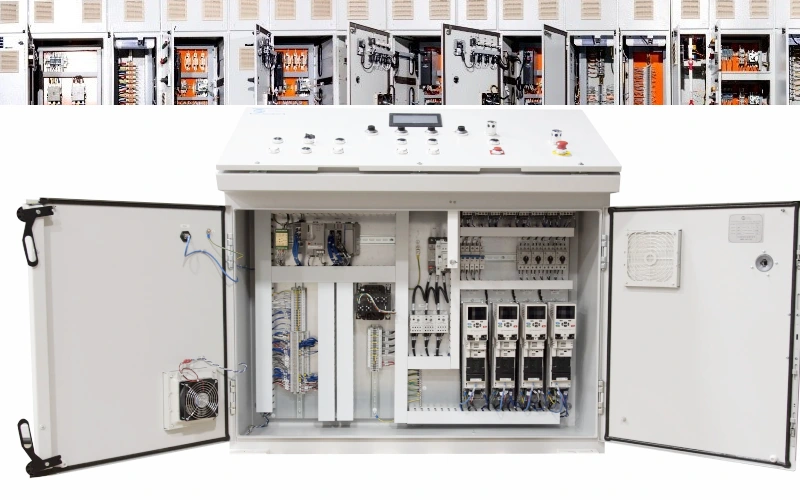 The configuration of communication protocols needs to precisely match the system architecture. For the Modbus RTU protocol, the baud rate is typically set at 9600bps (error range ±0.1%), with 8 data bits, 1 stop bit, and no parity check. In the BACnet IP network, the device instance number must be unique throughout the entire network. Incorrect subnet mask configuration can lead to 28% communication timeout failures. After installation, the protocol analyzer should be used to verify the integrity of data transmission to ensure that the bit error rate is less than 0.001%.
Full-function verification needs to be carried out during the system calibration and testing phase. The calibration accuracy of the temperature sensor should reach ±0.5°C, and the calibration range of the humidity sensor should be 20-80%RH (with an error of ±3%). The operating parameters should be monitored through a data logger. In the cooling mode, the outlet temperature should drop by 8-10°C within 15 minutes, and in the heating mode, the heating rate should reach 4-6°C per hour. According to the ASHRAE Guideline 36 standard, a 72-hour continuous operation test is required after installation, and the system availability index should reach above 99.8%.
Safety compliance checks cover multiple dimensions. After installation is completed, the electromagnetic radiation intensity must be measured to ensure that the radiation value in the 30MHz-1GHz frequency band is below 40dBμV/m (quasi-peak). According to the requirements of NFPA 70, all exposed conductive components shall be subject to double insulation protection, and the insulation strength test shall withstand 1500V AC voltage for 60 seconds without breakdown. The grounding continuity test requires that the grounding impedance be less than 0.5Ω and the leakage current not exceed 3.5mA. These measures have reduced the rate of electrical accidents by 92%.
The configuration of communication protocols needs to precisely match the system architecture. For the Modbus RTU protocol, the baud rate is typically set at 9600bps (error range ±0.1%), with 8 data bits, 1 stop bit, and no parity check. In the BACnet IP network, the device instance number must be unique throughout the entire network. Incorrect subnet mask configuration can lead to 28% communication timeout failures. After installation, the protocol analyzer should be used to verify the integrity of data transmission to ensure that the bit error rate is less than 0.001%.
Full-function verification needs to be carried out during the system calibration and testing phase. The calibration accuracy of the temperature sensor should reach ±0.5°C, and the calibration range of the humidity sensor should be 20-80%RH (with an error of ±3%). The operating parameters should be monitored through a data logger. In the cooling mode, the outlet temperature should drop by 8-10°C within 15 minutes, and in the heating mode, the heating rate should reach 4-6°C per hour. According to the ASHRAE Guideline 36 standard, a 72-hour continuous operation test is required after installation, and the system availability index should reach above 99.8%.
Safety compliance checks cover multiple dimensions. After installation is completed, the electromagnetic radiation intensity must be measured to ensure that the radiation value in the 30MHz-1GHz frequency band is below 40dBμV/m (quasi-peak). According to the requirements of NFPA 70, all exposed conductive components shall be subject to double insulation protection, and the insulation strength test shall withstand 1500V AC voltage for 60 seconds without breakdown. The grounding continuity test requires that the grounding impedance be less than 0.5Ω and the leakage current not exceed 3.5mA. These measures have reduced the rate of electrical accidents by 92%.
The configuration of communication protocols needs to precisely match the system architecture. For the Modbus RTU protocol, the baud rate is typically set at 9600bps (error range ±0.1%), with 8 data bits, 1 stop bit, and no parity check. In the BACnet IP network, the device instance number must be unique throughout the entire network. Incorrect subnet mask configuration can lead to 28% communication timeout failures. After installation, the protocol analyzer should be used to verify the integrity of data transmission to ensure that the bit error rate is less than 0.001%.
Full-function verification needs to be carried out during the system calibration and testing phase. The calibration accuracy of the temperature sensor should reach ±0.5°C, and the calibration range of the humidity sensor should be 20-80%RH (with an error of ±3%). The operating parameters should be monitored through a data logger. In the cooling mode, the outlet temperature should drop by 8-10°C within 15 minutes, and in the heating mode, the heating rate should reach 4-6°C per hour. According to the ASHRAE Guideline 36 standard, a 72-hour continuous operation test is required after installation, and the system availability index should reach above 99.8%.
Safety compliance checks cover multiple dimensions. After installation is completed, the electromagnetic radiation intensity must be measured to ensure that the radiation value in the 30MHz-1GHz frequency band is below 40dBμV/m (quasi-peak). According to the requirements of NFPA 70, all exposed conductive components shall be subject to double insulation protection, and the insulation strength test shall withstand 1500V AC voltage for 60 seconds without breakdown. The grounding continuity test requires that the grounding impedance be less than 0.5Ω and the leakage current not exceed 3.5mA. These measures have reduced the rate of electrical accidents by 92%.
Published on Mafi Wasta · Established 2020 · Mar Mikhael, Beirut