
OSB Grades 1, 2 and 3: Matching Panel to Exposure
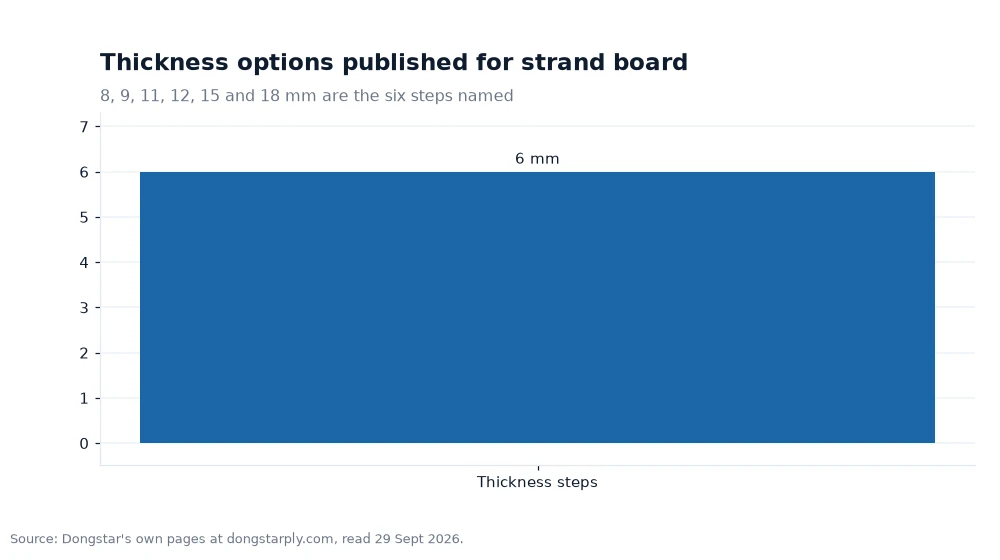
Strand board is graded by where it can be used, not by how it looks, and the three classes on the published datasheet run from dry interior work to load-bearing floors. The same source lists six thickness steps — thicknesses of 8 mm, 9 mm, 11 mm, 12 mm, 15 mm and 18 mm — in a 1220 × 2440 mm format, with poplar, pine or eucalyptus strand under the surface. Choosing between OSB 1, OSB 2 and OSB 3 is a question about moisture and load first, and about price second.

Key takeaways
- Settle exposure before price: OSB 1 is limited to dry, non-structural work, OSB 2 covers general dry-condition uses, and OSB 3 is the structural class for humid conditions and load.
- Six thickness steps are published — 8, 9, 11, 12, 15 and 18 mm — in a 1220 × 2440 mm format, with customised sizes offered alongside them.
- The resin list belongs to the grade rather than sitting beside it: from MR through E2, E1 and E0 to ENF, PMDI, WBP, melamine and phenolic are all named.
- Core species — poplar, pine or eucalyptus — changes panel weight and how the sheet takes a screw, while leaving the grade label untouched.
Why the grade label carries more than a face photo
A strand board panel looks the same whatever it was built for. Wood strands are laid in layers, bonded with resin and pressed into a sheet, and the face leaving the press gives away very little about the resin system, the density or the exposure class underneath. That is why the published specification splits OSB 1, OSB 2 and OSB 3 by service condition rather than by appearance — the number is the only dependable signal of where the panel belongs.
For an importer or a contractor the practical effect is blunt. A purchase order reading only "strand board, 15 mm" leaves the most valuable variable open, and two mills can fill that line with sheets that photograph identically and behave differently after one humid season. Naming the grade, the thickness and the resin turns an open line into something a receiving clerk can tick against a datasheet on arrival.
Grade 1 covers dry service, not floors
The page Dongstar publishes for Oriented Strand Board OSB puts the basic class first: dry conditions indoors, non-structural duty, with packaging and pallets given as the typical jobs. That is a boundary rather than a verdict. A panel doing honest work inside a dry warehouse is simply the wrong sheet for a shower wall or an exposed roof deck, and no amount of careful fixing changes that.
Trouble starts when a quotation leaves the boundary out. A line that says only "OSB" may be filled from whichever class happens to be running that week, and the gap surfaces months later in a damp corner rather than at the loading dock. Writing the class into the order — plus the thickness and the resin — costs one line of text and removes the ambiguity altogether.
Grade 2: the general-purpose middle
The middle class is described for dry conditions and general building work: furniture, DIY projects and moderate load-bearing duty. It is the class most interior fit-out specifications land on, because panels used inside a heated or ventilated building rarely meet standing water, and the price sits below the structural sheet.
Where grade 2 earns its keep is in mixed orders. A fabricator making cabinets, workshop jigs and light partitions can run one class across all three jobs, which simplifies stock and reduces the chance of the wrong sheet being cut for the wrong task. What it does not do is cover a floor that will see weather during construction, or a wall that will stay damp for weeks.
Grade 3 is the structural class
OSB 3 is described as the structural grade for humid conditions and load-bearing use, with flooring, roof decking, wall sheathing and structural components named as the applications. In practice this is the class a site engineer wants when panels must carry weight and stay dimensionally steady while the building is still open to the weather.
Ordering it early matters more than ordering it cheaply. Structural panels are usually the first board on a site and the last one covered, so a delayed shipment holds up follow-on trades. Importers who plan structural strand board against a realistic production window — not against a hopeful one — are the ones who keep their installation programmes intact.
Thickness and resin follow the grade
The six published thickness steps are 8, 9, 11, 12, 15 and 18 mm. Thicker sheets stiffen a span and take fixings with more margin, thinner ones suit lining, packaging and lightweight furniture components. Above the thickness row sits the resin list: MR for interior value, E2, E1 and E0 as emission labels, ENF as the environment-friendly option, PMDI for strength and moisture resistance together, and WBP, melamine or phenolic for water resistance in outdoor and humid service.
Core species close the specification. Poplar, pine and eucalyptus strands are all named, and the choice shifts panel weight and density as much as it shifts price. A buyer comparing quotations per square metre without checking density is comparing two different products, because the same nominal thickness can be pressed from strands of quite different mass.
| Field | Published value | What it settles on site |
|---|---|---|
| OSB 1 | Dry interior conditions, non-structural | Packaging, pallets and similar dry-service work |
| OSB 2 | Dry conditions, general-purpose | Furniture, DIY and general building at moderate load |
| OSB 3 | Humid conditions, load-bearing duty | Floors, roof decking, wall sheathing, structural parts |
| Thickness | 8, 9, 11, 12, 15, 18 mm | Stiffness across a span and fixing depth |
| Resin | MR, E2, E1, E0, ENF, PMDI, WBP, melamine, phenolic | Moisture tolerance and formaldehyde emission class |
Worked example: area and cubic volume from one order
Say a distributor orders 400 sheets in the 1220 × 2440 mm format. In metres the sheet is 1.22 m × 2.44 m = 2.9768 m², so 400 × 2.9768 = 1,190.7 m² of panel surface (example arithmetic). That number is what a cutting plan and a materials take-off are priced against, and it does not change when the thickness does.
Thickness does change the cube, and freight is priced on the cube. At 18 mm one sheet is 2.9768 × 0.018 = 0.0536 m³, so 400 sheets measure 400 × 0.0536 = 21.43 m³ (example). At 12 mm the same sheet count is 2.9768 × 0.012 = 0.0357 m³ per sheet, or 14.29 m³ in total (example) — 50% less volume carried for the same 400 units. Running that calculation before the quotation is confirmed is the difference between comparing two prices and comparing two products.
Frequently asked questions
Does a higher grade number mean a better panel?
No. The number says where the panel is allowed to be used. OSB 1 is limited to dry interior, non-structural work such as packaging and pallets, OSB 2 covers general dry-condition uses including furniture and light building work, and OSB 3 is the structural class for humid conditions and load-bearing duty.
Can one panel cover both a pallet and a floor?
Only if it is specified as the structural class. A panel ordered in grade 1 is intended for dry, non-structural work, while flooring, roof decking and other load-bearing applications sit in grade 3, which is the class described for humid conditions as well.
Which resin should be requested for humid sites?
The published list names PMDI for strength and moisture resistance together, and WBP or phenolic for water resistance in outdoor and humid conditions. Melamine is also listed for moisture tolerance with a good surface, while MR is the economical choice for interior work.
Where the specification continues
Grade is one line on a datasheet, and the resin row underneath it decides as much as the label does. Buyers who want to see how the classes, thickness steps and resin systems sit next to the rest of the family can read the wider panel line-up and then check the company structure behind the brand, so the entity on the contract is the entity named on the certificate.
Grade definitions, thickness steps and resin names were read on 29 Sept 2026 from the factory's own website, read on 29 September 2026, as applied to this guide[1].