
Mining Profitability in 2026: Reading the Numbers Correctly
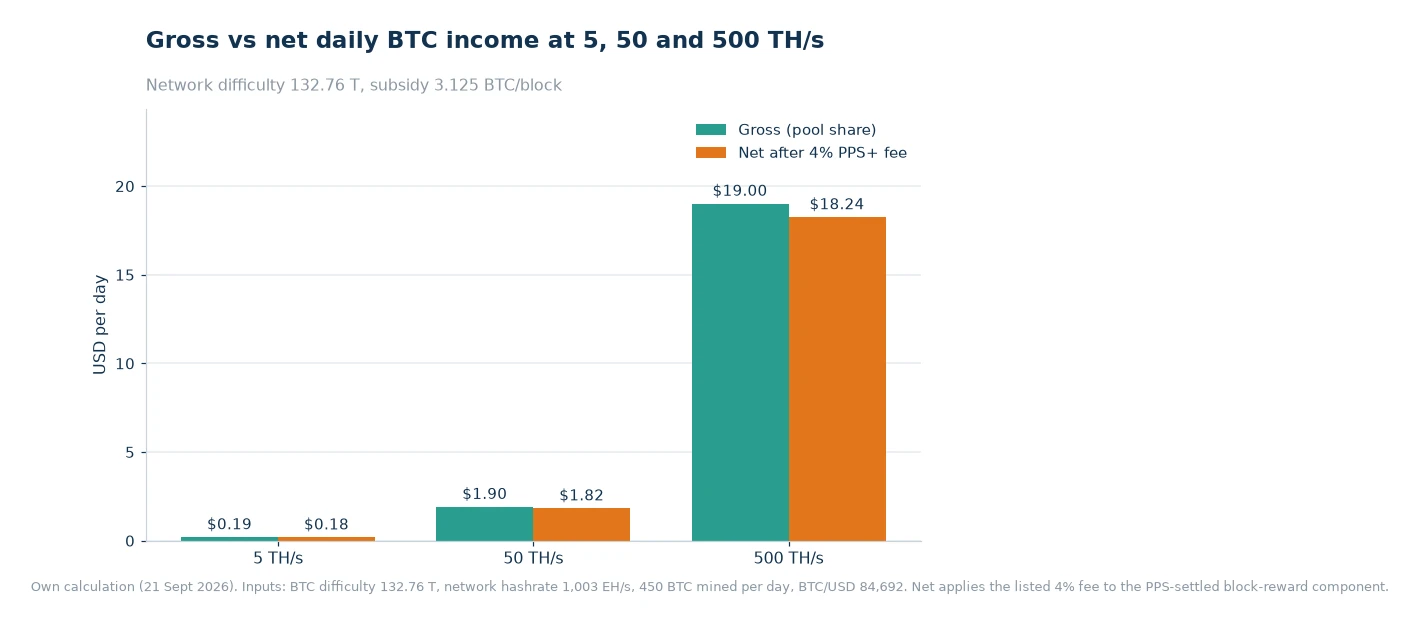
At a BTC price of $84,692 and a network difficulty of 132.76 T, one terahash per second is worth about $0.038 of gross revenue a day. Half a petahash therefore produces roughly $19.00 a day before power and $18.24 after the listed 4% fee on the PPS-settled block reward, which is why profitability is a subtraction problem rather than a hashrate contest.

Key takeaways
- At difficulty 132.76 T and a BTC price of $84,692, 1 TH/s returns about 0.00000045 BTC — $0.038 — per day, and income scales almost exactly linearly with hashrate.
- A 500 TH/s rig returns about $19.00 a day gross; at 20 J/TH that is 10 kW, 240 kWh a day and roughly $14.40 of power at $0.06/kWh, leaving about $3.84 a day after the listed 4% PPS+ block-reward fee.
- PPS+ is not a flat 6% haircut: the listed fee is 4% on the PPS-settled block reward and 2% on the PPLNS-distributed transaction-fee component, which is usually the smaller part of a payout.
- Settlement cadence changes cash flow, not the expected total: at 1 PH/s, hourly settlement returns about 0.0000187 BTC — roughly $1.58 — every hour.
Why the numbers move
Bitcoin's difficulty adjustment exists to keep blocks arriving close to every ten minutes, whatever the total hashrate does. With a subsidy of 3.125 BTC per block and 144 blocks a day, the network issues 450 BTC a day — about $38.1 million at the 21 September 2026 price. Nothing an individual miner does changes that figure. What changes is the fraction of it they can claim.
That fraction is simply your hashrate divided by network hashrate, which stood at roughly 1,003 EH/s (1,003,107,267,295 GH/s) when these numbers were read. The whole calculation fits in one line: your hashrate ÷ network hashrate × 450 BTC × (1 − your effective fee). Everything else — interface design, mobile notifications, the number of coins a pool supports — is convenience wrapped around that division.
Difficulty is not static, and neither is price. A reading taken on 21 September 2026 put the next difficulty adjustment at an estimated −2.12%, which would lift per-terahash income slightly if it lands. It is a reminder that any profitability table has a shelf life measured in days, not quarters.
What changes your payout
Three levers move the money once hashrate is fixed. The first is the payment method and where the listed fee attaches. ViaBTC publishes two methods: PPS+, which is the default, and PPLNS.[1] Under PPS+ the block-reward component is settled per share at a listed 4% fee, because the pool absorbs pool-luck and orphaned-block risk on the miner's behalf; the transaction-fee component is distributed with PPLNS logic at a listed 2% fee. Under PPLNS the two components are merged and distributed together at a listed 2% fee, and the miner carries the variance.
The second lever is cadence. PPS+ pays hourly against current difficulty, while PPLNS distributes after a block reaches six confirmations, weighted by each miner's share of pool hashrate across the last five difficulty rounds. The third is uptime: a rig that silently drops to half its nominal hashrate still burns the same power.
That last point is why a mining pool dashboard that reports per-worker hashrate matters more than any headline statistic. The gap between what a machine is rated at and what the pool actually credits is where monthly surprises come from.
| Input | Reading on 21 September 2026 | Sensitivity |
|---|---|---|
| BTC price | $84,692 | A 1% move is about ±$0.19 a day on 500 TH/s |
| Network difficulty | 132.76 T (next adjustment estimated at −2.12%) | A 10% difficulty rise removes about 9.1% of gross income |
| Listed fee attachment | 4% on the PPS-settled block reward, 2% on the PPLNS-distributed fee component | The 4% component is worth about $0.76 a day on 500 TH/s |
| Electricity | $0.06/kWh assumed, 20 J/TH hardware | Each extra cent per kWh costs about $2.40 a day at 10 kW |
Worked example: a 500 TH/s rig, line by line
Start with the division. At 132.76 T and 1,003 EH/s of network hashrate, 500 TH/s is 0.0000005 of the network, and 450 BTC a day multiplied by that share gives 0.00022430 BTC a day. At $84,692 that is $19.00 gross. Applying the listed 4% fee to the block-reward component leaves $18.24. So far the arithmetic is clean and boring.
Now subtract power. Five hundred terahash at 20 J/TH draws 10,000 W — 10 kW, or 240 kWh across a day. At $0.06/kWh that is $14.40. The contribution is therefore about $3.84 a day, roughly $115 a month and about $1,400 a year, before any other cost. Change the tariff to $0.09/kWh and the same rig loses about $2.16 a day; halve the efficiency to 40 J/TH and the power bill doubles to $28.80, which turns a profitable machine into a negative one without touching hashrate or price.
That is the pattern for every tier. A 5 TH/s allocation earns about $0.19 a day gross, and a 50 TH/s allocation about $1.90 — figures worth checking against your own tariff rather than against a marketing page. Because the whole calculation is one division and one subtraction, it is worth confirming the inputs you are dividing by; ViaBTC Bitcoin Mining publishes mining statistics covering pool hashrate, network hashrate and difficulty, so the denominator is something you can verify instead of assume.
What to check monthly
- Fee attachment, not fee headline. A 4% charge on one component and a 4% charge on everything are different numbers. Multiply both by your own gross income before comparing pools.
- Realised hashrate versus rated hashrate. Compare the pool's credited hashrate with the nameplate figure. A persistent 3% shortfall usually means firmware, thermal throttling or a failing power supply.
- Difficulty and price together. Track them as a ratio. If difficulty rises 8% while price is flat, your income per terahash falls by about 7.4%.
- Cash-flow mechanics. Check the payout threshold and cadence against your power invoices. Hourly settlement of a small balance still needs a payment rail that does not eat the balance in fees.
- Forward planning. Before buying or retiring hardware, run price, difficulty, PPS fee rate and effective hashrate through a model rather than a spreadsheet sketch. ViaBTC's profit calculator takes those four inputs and also includes merged-mining output, which many third-party calculators omit.
Frequently asked questions
Do mining pools cost anything to join?
Joining is free; the pool earns from its fee on settled payouts, which appears as a percentage of the block-reward and transaction-fee components.
Can I mine more than one coin at the same time?
Yes. Merged mining lets a machine secure a parent chain and an auxiliary chain together, and multi-coin pools support switching between chains without moving hardware.
At what electricity price does a modern rig stop covering its power bill?
Work it out per terahash. At difficulty 132.76 T each TH/s produces about $0.038 of gross revenue a day and consumes 0.48 kWh on 20 J/TH hardware. After the listed 4% fee, that covers power up to roughly $0.076/kWh; above that, the machine is mining at a loss until price or difficulty moves.
The short version
Read profitability as two lines, not one: what the pool credits you, and what the wall socket takes back. Confirm which component the listed fee attaches to, verify your realised hashrate rather than trusting the nameplate, and re-run the numbers when difficulty or price moves by more than a few percent. At today's readings a well-sited 500 TH/s rig clears about $3.84 a day — enough to matter, and thin enough that a single cost assumption decides the outcome.
Data and sources: ViaBTC pricing[1] and the ViaBTC fee breakdown[2]. Network difficulty, network hashrate and the BTC price used in every figure above were read from public chain data and market feeds on 21 September 2026; income is calculated as hashrate ÷ network hashrate × 450 BTC × (1 − fee). Power costs are illustrative and depend on your tariff and hardware efficiency.